Hampi:
Hampi , also referred to as the Group of Monuments at Hampi, is a UNESCO World Heritage Site located in east-central Karnataka, India.Located close to the Andhra Pradesh border and near the modern era city of Hosapete, Hampi was established as the capital of the Hindu Vijayanagara Empire in the 14th-century.Chronicles left by Persian and European travelers particularly the Portuguese state Hampi as a prosperous, wealthy and grand city near the Tungabhadra river with numerous temples, farms and trading markets. The Vijayanagara Empire was defeated by a coalition of Muslim Sultanates, its capital Hampi was conquered, pillaged and badly damaged by Sultanate armies in 1565, after which Hampi remained in ruins.
Hampi monuments are spread over 4,100 hectares and has been described by UNESCO as "austere, grandiose site" of more than 1,600 surviving remains of the last great Hindu kingdom in South India, that include "forts, riverside features, royal and sacred complexes, temples, shrines, pillared halls, mandapas, memorial structures, water structures and others". Hampi predates the Vijayanagara Empire, with evidence of Ashokan epigraphy and its mention in the Ramayana and the Puranas of Hinduism as Pampaa Devi Tirtha Kshetra. Hampi continues to be an important religious centre, housing the Virupaksha Temple, an active Adi Shankara-linked monastery, and various monuments belonging to the old city.
Hampi has quite a number of tourist attractions like Virupaksha Temple, Vithala Temple and Nandi Statue. It is best to visit Hampi during the three day long Hampi festival held around October-November every year. Read more about Hampi.
Jewel of hampi - Stone chariot
Every tourist place has that one spot which earns it galore and admiration. For Hampi, the small, dainty temple village set in Karnataka, it’s the iconic stone chariot. It’s the leading man in the army of exquisite beautiful sights that Hampi has to offer and depicts Karnataka tourism an icon itself. The chariot is actually .

The Jewel of Hampi- The Stone Chariot
Every tourist place has that one spot which earns it galore and admiration. For Hampi, the small, dainty temple village set in Karnataka, it’s the iconic stone chariot. It’s the leading man in the army of exquisite beautiful sights that Hampi has to offer and depicts Karnataka tourism an icon itself.
Stone Chariot, Vittala Temple, Hampi, facts about Hampi
Stone Chariot at Vittala Temple, Hampi
The chariot is actually a shrine dedicated to Garuda, built inside the Vittala Temple Complex. The massive sculpture of Garuda, Lord Vishnu’s escort once was seated atop the chariot but it is empty at the present date. The Hampi Chariot has earned its name among the other three famous stone chariots in India- One in Konark, Odissa, and the other in Mahabalipuram (Tamil Nadu).
The chariot was built by King Krishnadevaraya of the Vijayanagara Empire during the 16th century, who got fascinated with the Konark Sun temple chariot while fighting a battle in Odissa. The chariot is meant to represent the beauty and artistic perfection of the Empire. An interesting folklore emanates from the Hampi chariot as villagers believe that the world would come to a halt when the chariot moves from its place. It has come to have a sacrosanct presence and is internationally recognized as a world heritage site even by the UNESCO
Virupaksha Temple
 The Virupaksha or the Pampapathi temple is the main center of pilgrimage at Hampi. It is fully intact, and it incorporates some earlier structures. This temple has three towers, the eastern tower rises to a height of 160 feet and is nine tiered. It dates back to the first half of the fifteenth century and was renovated in the sixteenth century by Krishnadevaraya.
This tower has been built such that an inverted shadow of this huge tower falls on the western wall of the temple through a small hole behind the sanctum. The northern gopuram has five storeys, and the inner eastern gopuram is endowed with three storeys.
The presiding deity here is Virupaksheshwara or Pampapathi. His consort Pampa, is believed to be the daughter of Bhrama. There is an ornate shrine to Bhuvaneswari. There is a shrine to Vidyaranya, the spiritual founder of Vijayanagar in this temple. The inner prakaram consists of shrines and pillars dating back to the 12th century.
Krishnadevaraya also built a mandapam in front of the sanctum, and embellished it with Vijayanagar style bas reliefs and murals. Several of Shiva's manifestations, and the ten incarnations of Vishnu are portrayed here, as is the classic scene from Mahabharata depicting Arjuna's shooting the fish device in order to secure Draupadi's hand in marriage. There is also a mural depicting Vidyaranya the spiritual founder of Vijayanagar in procession.
Lotus Mahal Hampi/Chitrangini Maha/Kamal Mahal :

The style of it is a pleasant departure from the typical architecture you see in Hampi. The exact function of this is not surely known. Located inside the Zenana enclosure, most probably this was a socializing area for the women folks in the royal family.
Also known as Chitrangani Mahal and Kamal Mahal, this falls under the secular or nonreligious categories of structures in Hampi. It’s peculiar to note that this is one of the beautiful structures that were left undamaged during the siege of the city. However there are some signs of mutilations on a few sculptures placed on the outer surface.
Unlike the other major structures in Hampi, this is made out of lime mortar and brick made composition.
The shape of the structure is what brought it the name. The archways and the balcony with the domed construction resemble a half opened lotus bud. Also is the lotus bud shape carved on to the center dome.
Basically this is a two storied structure with an open base floor the sidewalls are having tall arched windows. The upper floors have balconies with arched windows. Hook like structures are made on to the wall close to the windows to hang curtain. The arches of the ground floor are recessed and ornate. The decorations and architecture is a curious mix of Hindu and Islamic styles. Lotus Mahal's Islamic style arches and the Hindu style multiplayer roof and base structure are often quoted for the ingenuity of the Vijayanagara artisans.
The night illumination is a spectacular sight. Undoubtedly this is a very photogenic and one of the most photographed buildings at Hampi. There is a large lawn made around the Lotus Mahal.
 One of the most impressive sites in Hampi, The Elephant Stables is a wonderful structure that provided shelter to the royal elephants of the grand Vijayanagara Empire. The intricate design and emphasis on little details indicate the importance that was attached to the royal elephants of the empire.
 The Krishna temple, also called Balakrishna temple, is about a kilometer to the south of Virupaksha temple, on the other side of the Hemakuta hill. It is dated to 1515 CE, and this part of the Hampi complex is called Krishnapura in inscriptions. In front of the ruined temple is a long market street (also referred to locally as the bazaar). Between the colonnaded stone shop ruins is a broad road allowing chariots to bring and carry away goods to the market, as well as host ceremonial functions and festive celebrations. To the north of this road and middle of the market is a large Pushkarani or public utility stepped water tank with an artistic pavilion in its center. Next to the tank is a public hall (mandapa) for people to sit.
 The temple opens to the east, has a gateway with reliefs of all ten avatars of Vishnu starting with Matsya at the bottom. Inside is the ruined temple for Krishna, as well as small ruined shrines for goddesses.The temple compound is layered into mandapas, including an outer enclosure and an inner enclosure. The compound has two gopura entrances. Inside a 25 (5x5) bay open mandapa leads to a 9 (3x3) bay enclosed mandapa. The original image of Balakrishna (baby Krishna) in its sanctum is now in a Chennai Museum. A modern road passes in front of the east side gopura, linking
 This temple is an open pavilion with a statue of the Hindu god Ganesha carved from a single rock.

 Vittala Temple was originally built during the 15th century and later embellished further by several kings over the years. A town by the name Vittalapura existed around the temple and its remains can be seen to this present day.
 Ahmad Khan mosque and tomb[edit]
The shape of the structure is what brought it the name. The archways and the balcony with the domed construction resemble a half opened lotus bud. Also is the lotus bud shape carved on to the center dome.
Basically this is a two storied structure with an open base floor the sidewalls are having tall arched windows. The upper floors have balconies with arched windows. Hook like structures are made on to the wall close to the windows to hang curtain. The arches of the ground floor are recessed and ornate. The decorations and architecture is a curious mix of Hindu and Islamic styles. Lotus Mahal's Islamic style arches and the Hindu style multiplayer roof and base structure are often quoted for the ingenuity of the Vijayanagara artisans.
The night illumination is a spectacular sight. Undoubtedly this is a very photogenic and one of the most photographed buildings at Hampi. There is a large lawn made around the Lotus Mahal.
Elephant Stable:
Indo-Islamic style structure used as the stables for the royal elephants of the Vijayanagara Empire
One of the most impressive sites in Hampi, The Elephant Stables is a wonderful structure that provided shelter to the royal elephants of the grand Vijayanagara Empire. The intricate design and emphasis on little details indicate the importance that was attached to the royal elephants of the empire.
The elephant stables were built in the 15th century and are constructed in the Indo-Islamic style of architecture. The structure is an elongated building with domed chambers, which are large enough to accommodate two elephants at a time. There are eleven such domed chambers and these are interconnected with large arched openings.
This elegantly symmetric structure is a magnet for large number of tourists who travel to Hampi. It is also one of the few structures, of the many other exquisite buildings of the area, which has suffered least destruction due to the ravages of the time.
The central dome is the largest and most closely designed with exquisite architecture. All the chambers have high ceilings and have a small opening at the rear from where the mahouts could enter and exit. Another interest is a central hook embedded in the ceiling of the central dome which was most probably used to hook the elephants and a hidden staircase, used to reach to roof of the building.
The building of Elephant Stables is located in the area that is situated just outside the Zenana Enclosure. It is nevertheless, a major attraction and wonderfully displays the level of craftsmanship that was reached during the contemporary times.
Krishna temple, market, Narasimha and linga:
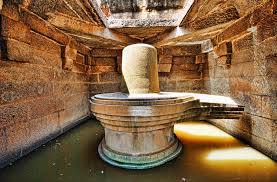
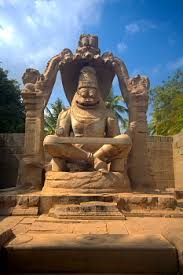
Shiva linga and fierce Yoga-Narasimha monoliths carved in-situ. Narasimha is damaged, his pedestal has burn marks.
Kamalapuram to Hampi. The west side gopura has friezes of battle formation and soldiers.
South of the Krishna temple outside are two shrines immediately next to each other, one containing the largest monolithic Shiva Linga and the other with the largest monolithic Yoga-Narasimha avatar of Vishnu in Hampi. The 3 metres (9.8 ft) Shiva Linga stands in water in cubical chamber, has three eyes sketched on its top. South of it is the shrine for a 6.7 metres (22 ft) high Narasimha – the man-lion avatar of Vishnu, seated in a yoga position. The Narasimha monolith originally had goddess Lakshmi with him, but it shows signs of extensive damage and attempts to burn the shrine down because the floor is stained with carbon. The statue has been cleaned and parts of the shrine has been restored.
Sasivekalu Ganapa:
This temple is an open pavilion with a statue of the Hindu god Ganesha carved from a single rock.
The specialty of this temple is the huge monolithic statue of Lord Ganesha which was built by a rich trader of chandragiri, which is the present day Andhra Pradesh. This temple was built in the honor of King Narasimha II. The idol of Lord Ganesha here holds a noosh in one hand, a modak in another, his broken tusk in the third and an axe in the fourth. It is said that once Ganesha ate so much that his belly was about to burst and so he took a snake and tied it round his belly as a belt. Even in this temple there is a snake carved on the belly of Lord Ganesha according to this story. This temple is on the southern foothills of the Hemakuta Hill and is almost in ruins.
Achyutha Raya Temple :
The Achyuta Raya Temple is in Hampi. It was built in 1534 AD. It is one of the major, splendid and awe-inspiring temples of Hampi located between the Matanga hills and Gandhamadana. This magnificent temple depicts Vijayanagara architecture style of temples in its best and most improved form. This was among the last dazzling temples that were constructed in the celebrated city of Hampi prior to the decline of the Vijayanagara Empire
Vittala Temple:
Vittala Temple was originally built during the 15th century and later embellished further by several kings over the years. A town by the name Vittalapura existed around the temple and its remains can be seen to this present day.
The highlight of Vittala Temple is its pillars and stone chariot. The halls are carved with an impressive and fascinating array of sculptures etched on to the magnificent pillars. The stone chariot stands as an iconic replica of Hampi.
Jain monuments:
Ganagitti Jain temple
Reliefs of Jain temples are present in this area that includes Hemkut Jain temples, Ratnantraykut, Parsvanath Charan and Ganagitti Jain temples. Most of the idols are now missing from these temples. Ruins suggest that these temples belong to 14th century.
Ganagitti temple complex
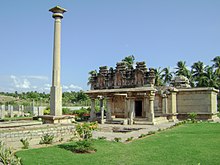 The Ganigitti Jain temple is near Bhima's gate, in the southeast part of the urban core section of Hampi. In front, it has a monolithic lamp pillar. The temple faced north-facing temple. It is dated to 1385 CE, built during the rule of Hindu king Harihara II, based on an inscription found within the temple. It is dedicated to Tirthankara Kunthunatha. The temple features plain walls, a pillared mandapa, a square sanctum where the Jina's statue is missing. The capitals on the pillars and the doorways have decoration. Over the sanctum is a Dravidian-style narrowing square pyramidal tower. Other monuments in the temple compound are in ruins.
The Ganigitti Jain temple is near Bhima's gate, in the southeast part of the urban core section of Hampi. In front, it has a monolithic lamp pillar. The temple faced north-facing temple. It is dated to 1385 CE, built during the rule of Hindu king Harihara II, based on an inscription found within the temple. It is dedicated to Tirthankara Kunthunatha. The temple features plain walls, a pillared mandapa, a square sanctum where the Jina's statue is missing. The capitals on the pillars and the doorways have decoration. Over the sanctum is a Dravidian-style narrowing square pyramidal tower. Other monuments in the temple compound are in ruins.
Other Jain temples and monuments[edit]
A cluster of Jain and Hindu temples are co-located about 150 meters east of the Elephant stables. One north facing temple is dedicated to Parshvanatha Tirthankara. It was built by king Devaraya II and dated to 1426 CE, per an inscription in the temple. In front of the temple are two ruined temples together, one of Shiva and other dedicated to the Mahavira.Jain Tirthankaras are also included in reliefs found inside Hindu temples.
Muslim monuments:
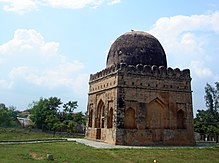
Ahmad Khan tomb in Hampi
The Hampi site includes a Muslim quarter, with Islamic tombs, two mosques and a cemetry. These are neither in the sacred center nor in the royal center of the Hampi site. Some Muslim monuments are a part of the urban core while others are in the suburbs where most Vijayanagara residents lived. These are found in the northeast valley of urban core, where settlements of Hindus and Jains are also found. Much of this region is deeply silted and soil has buried temples, roads, water tanks, gateways and residential quarters that were abandoned.
Ahmad Khan mosque and tomb[edit]
There is a Muslim monument in the southeastern part of the urban core on the road from Kamalapura to Anegondi, before Turuttu canal in the irrigated valley. This monument was first built in 1439 by Ahmad Khan, a Muslim officer in the army of Hindu king Devaraya II. The monuments include a mosque, an octagonal well and a tomb. The mosque lacks a dome and is a pillared pavilion, while the tomb has a dome and arches.Other Muslim monuments and a graveyard were added later near the Ahmad Khan's legacy.
There are so many other places in hampi..
WORDS ARE NOT ENOUGH TO EXPRESS THE BEAUTY OF HAMPI,,,
TAKE A TRIP @
HAMPI .....HAVE A NICE JOURNY...


